Ages of Discord: A Structural-Demographic Analysis of American History by Peter Turchin
Author:Peter Turchin
Language: eng
Format: mobi, epub, pdf, azw3
Publisher: Beresta Books LLC
Published: 2017-03-07T23:00:00+00:00
PART THREE
A Complete Secular Cycle: from the Revolution to the Great Depression, c.1780–1930
7
Long-Term Trends, 1780–1930: a Synthesis
Goals of Part III
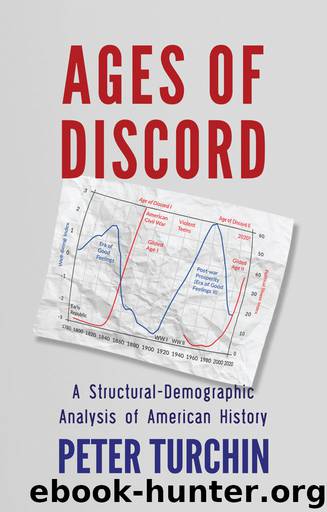
The empirical survey of structural-demographic dynamics in Part II suggests that between c.1780 and c.1930 the United States went through a complete secular cycle. As Chapters 3 to 6 documented, demographic, economic, social, and political variables during this period moved in a cyclic fashion. My approach so far has been to look at each variable, or group of variables, separately. However, the Structural-Demographic Theory posits that these variables are interconnected by a set of feedback loops; in other words, they are part of an integrated social system. The main goal of Part III will be to trace these feedback loops for the secular cycle of 1780–1930. Of particular interest are periods in American history when structural-demographic variables exhibit “trend-reversals”, which as we have seen in Part II, tend to happen at approximately the same time (within a decade or two) for very different kinds of variables (demographic, economic, political, and others). Explaining such trend reversals from the perspective of the Structural-Demographic Theory is, thus, a major goal of this part.
Accordingly, instead of describing the long-term dynamics of each variable, I now focus on how variables have affected each other in each historical period. Additionally, it was not always possible to obtain quantitative estimates of all variables of interest (of interest, that is, from the theoretical point of view). Thus, the second goal of Part III is to fill in the gaps with a more qualitative, narrative-based approach. Finally, social scientists have advanced a number of explanations for various turning points in American history—such as the Civil War and the New Deal, to name two of the most important milestones—and the third goal here will be to engage these theories and compare their answers with those offered by the structural-demographic model.
This chapter presents a summary of empirical trends during this secular cycle. The two trend reversals that define the cycle are discussed in a narrative manner in Chapters 8 and 10, respectively. Chapter 9 develops a quantitative model (using the conceptual framework developed in Chapter 2) that traces out the feedback loops connecting the population and elite variables.
Dynamic Interrelations Between Structural-Demographic Variables
Download
Ages of Discord: A Structural-Demographic Analysis of American History by Peter Turchin.epub
Ages of Discord: A Structural-Demographic Analysis of American History by Peter Turchin.pdf
Ages of Discord: A Structural-Demographic Analysis of American History by Peter Turchin.azw3
This site does not store any files on its server. We only index and link to content provided by other sites. Please contact the content providers to delete copyright contents if any and email us, we'll remove relevant links or contents immediately.
| Anthropology | Archaeology |
| Philosophy | Politics & Government |
| Social Sciences | Sociology |
| Women's Studies |
Cecilia; Or, Memoirs of an Heiress — Volume 1 by Fanny Burney(32558)
The Great Music City by Andrea Baker(32019)
Cecilia; Or, Memoirs of an Heiress — Volume 2 by Fanny Burney(31956)
Cecilia; Or, Memoirs of an Heiress — Volume 3 by Fanny Burney(31942)
We're Going to Need More Wine by Gabrielle Union(19046)
All the Missing Girls by Megan Miranda(16029)
Pimp by Iceberg Slim(14508)
For the Love of Europe by Rick Steves(14121)
Bombshells: Glamour Girls of a Lifetime by Sullivan Steve(14076)
Talking to Strangers by Malcolm Gladwell(13370)
Norse Mythology by Gaiman Neil(13365)
Fifty Shades Freed by E L James(13241)
Mindhunter: Inside the FBI's Elite Serial Crime Unit by John E. Douglas & Mark Olshaker(9343)
Crazy Rich Asians by Kevin Kwan(9292)
The Lost Art of Listening by Michael P. Nichols(7506)
Enlightenment Now: The Case for Reason, Science, Humanism, and Progress by Steven Pinker(7314)
The Four Agreements by Don Miguel Ruiz(6765)
Bad Blood by John Carreyrou(6622)
Weapons of Math Destruction by Cathy O'Neil(6281)
